A further text written by Tony Cappi.
-
" In an era that has been qualified as post-Fordist, one in which on-demand has replaced stock, the only goods still produced on an assembly line - that of the education system - without knowing for whom, nor why, are workers, including artists"
- Claire Fontaine
Since my last entry something has occurred to me regarding the structure of Fontaine, a reflection on how we handled the events of Wapping. I would like to contextualise this thought with a brief discussion of Brenda Dean.
Brenda Dean, General Secretary of the Society of Graphical and Allied Trades (SOGAT), was the first woman to head a major British trade union. Given that SOGAT employed the majority of News International’s print workers, she was the figurehead of the Wapping dispute, even invited in secrecy to negotiate on behalf of all involved unions by News International. It is the relationship between Dean, the workers, and the proprietors, that I would like to compare with the relationship between Fontaine, the artists behind her, and her consumers.
As General Secretary, Dean did not work in printing, she was the frontwoman, the boss. She had a great deal of power over her workers, her decisions held far more control over the lives of her workers than any individual worker held over her. That being said, although she was head of SOGAT, she worked for its members. The deals she argued were for them, her salary was paid for by their membership fees.
Dean was criticised heavily by SOGAT workers for being too soft on the proprietors. Just months before the Wapping dispute she had agreed a deal with Robbert Maxwell, losing 2,500 jobs at The Mirror. She was comparatively popular with Rupert Murdoch as she had a reputation for having a more level head than other union leaders at the time, although not much respected by him, he is quoted to have told a colleague he did not believe she had the “bottle” to control strikes among her members.
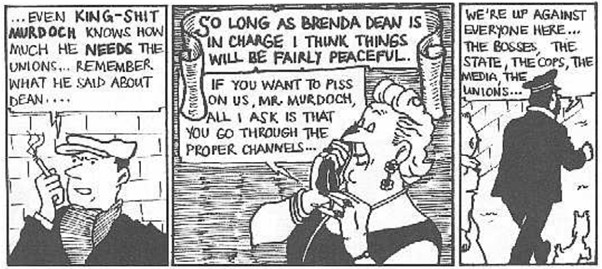
- A section of The Scum, a newspaper run by Wapping picketers
Truthfully, Brenda Dean operated at an extremely challenging time for Unions, she was ultimately forced into pragmatism and abiding by new Thatcherite laws that had almost completely depleted any powers Unions once held. SOGAT could no longer instruct it’s train delivery workers to black (not handle) News International newspapers, it could not allow workers from other sites to strike in solidarity with News International employees, a breach of these rules would have lost the Union millions, thereby completely destroying itself.
What is certainly not recognised enough, is that Brenda Dean managed all of this, kept the drowning SOGAT afloat, kept News International in negotiations, managed public opinion, whilst being a woman. Dean worked to lead a hugely male dominated industry, if she had been as volatile as her fellow union leaders, she would not have been extended a shred of the respect that they were given by proprietors. The standard of her actions, values, demeanour, and competency was held far higher than her peers, and although this is beginning to get a little off topic, I personally thought it necessary to address.
Returning to Claire Fontaine, a singular pseudonym representing a collective of artists, whose identity is formed and forced by how her consumers have allowed her too, we are now ready to make the comparison of Fontaine to Dean. We have discussed deans bilateral relationship with her Union members, and how her decisions as General Secretary were heavily forced by imposed state laws and the new powers that had been given to proprietors over Unions. Both Fontaine and Dean are given little control over themselves by consumers/proprietors, they both exist as a figurehead of the work of their artists/workers, they both are the tunnel through which the power of the consumer/proprietor is exerted over the artist/worker. The parallels between Fontaine and Dean now seem undeniably clear, what is next crucially important is the way in which they differ.
Fontaine rejects ideas of the self, whereas Dean, and 1980s British Trade Unionism as a whole, stands to support it. Fontaine states “the construction site of the self has always been a collective matter, a matter of interference and resistance, of the distribution of competencies and the division of tasks”, the division of tasks was of the upmost importance to and protected by the printer’s unions.
“Before Wapping”, I explained recently to a group of young journalists, “if any of you had done this” – I pressed a letter at random on the computer keyboard – “the print workers would have walked off the job and the paper wouldn’t come out.” They looked at me with a mixture of incomprehension and incredulity, not sure if I was making it up or taking them for a ride. The proposition was so ludicrous that there are times I wonder myself if it was true. But it was.
– Andrew Neil, former editor of The Sunday Times (quoted in The Guardian, 15 January 2006).
This quote refers to the severity of the division of work in the print industry. Print work is naturally made up of many different technical stages, each worked by a differently trained person, paid through a different system. Any one person moving between those roles was not acceptable and would like induce a strike or some industrial action, especially if a Journalist would have crossed the line into the composing room. Under TUC regulations, one Union cannot do the work that would have been traditionally done by another, this line being crossed by the EETPU (an electricians union who took the print jobs in Wapping) significantly damaged SOGAT and the AUEW. The protection of jobs, potentially the largest goal of trade unions, requires the distinction of jobs. The separation of person to person, the self from the other, was deeply intertwined within SOGAT.
The trade union exists to protect its members against capitalism, what undermines this is that it protects its members on capitalism’s terms. One could criticise and ask what might have happened at Wapping if the Unions were a little more like Clair Fontaine? What if they didn’t structure themselves around boundaries and discrete separations? But this criticism seems vastly unfair, Fontaine never had to protect the livelihood of thousands, Brenda Dean did. But to not ask for better would bring upon ourselves an inevitable defeat, the question is, what would that better look like?