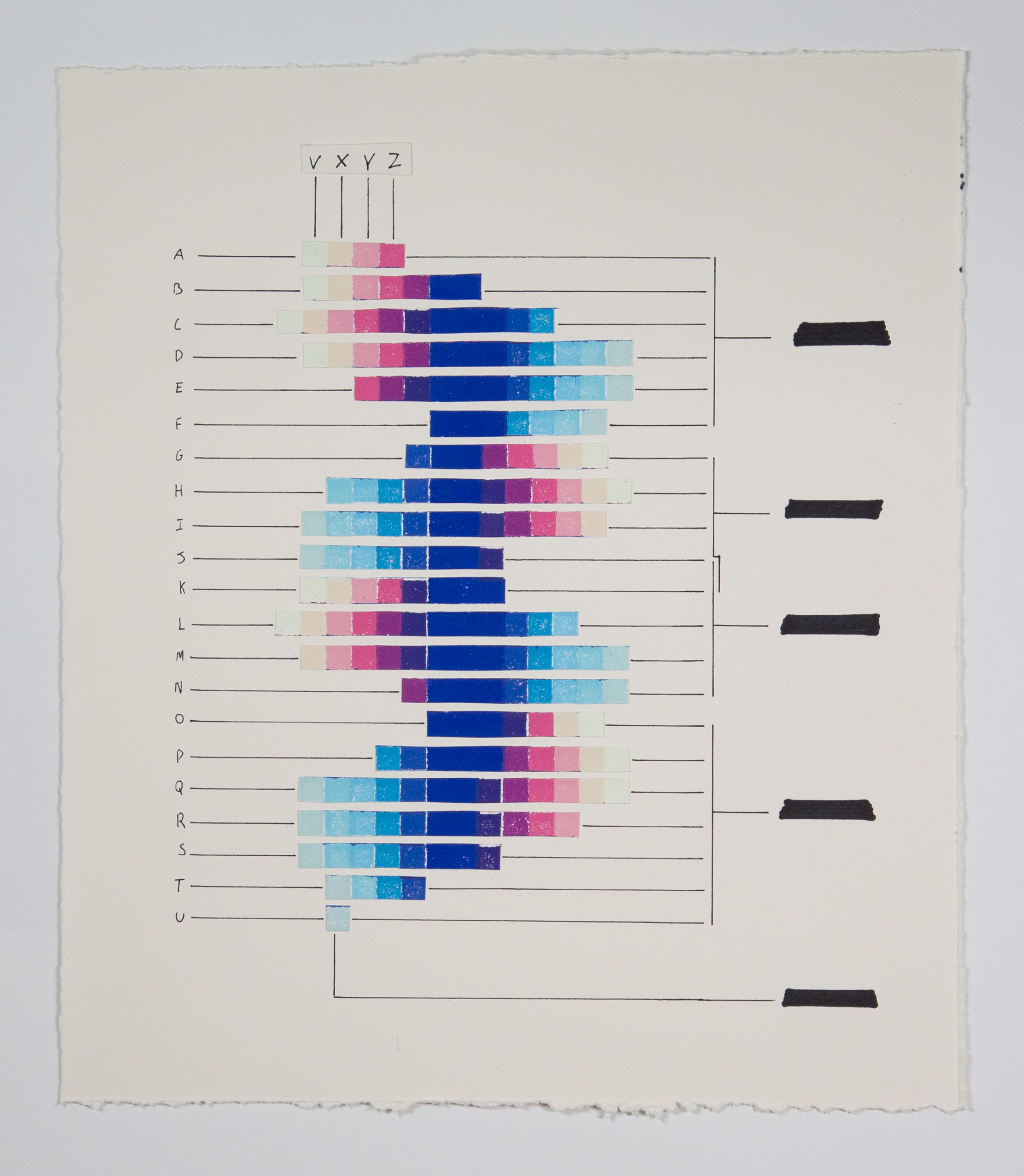
Anticipating shifts in media consumption, in the late 1980s, Tony Cappi began a new project designing a custom typeface for Stereotype. Designed around a modular system, the typeface could be arranged into any major alphabet. A forward-thinking concept set to revolutionise media circulation, the project was a first step to build an identity outside of the events of Wapping. Cappi began an initial test print run of a letter that he believed would become the single most important letter in the future of typography, circulation and knowledge.
Unfortunately, due to the complicated registration of printing a 12-layer typeface, and limitations in the resolution of Cappi’s carving work, the typeface took far too long to be printed and could not be scaled down to a practical font size. As such, it was not well received at its first presentation to Stereotype members. Cappi became frustrated that due to the chosen letter of the test prints people were making the assumption that the project was in some way linked to Wapping, describing the reaction as “robotic” and “pre-programmed”. The project was quickly scrapped, Cappi cut up the remaining prototype prints and disposed of the letterpress pieces he had made.
It was just under a year later when Terry Ellis revealed to Cappi that he had kept the remnants of a cut up print and had used them to develop a decoding system for the Fortress Wapping security network. Ellis had discovered that by analysing the distribution of particular letters in that day’s News International newspapers, and cross referencing them to the distribution of colour modules in the cut up prints, he could deduce that day’s rotated password in the Wapping security system.
For nearly ten years this method proved extremely useful to Stereotype, allowing the collection and leaking of many confidential documents from the plant. However, in late 1999, when the security system at Wapping was updated to patch the Y2k bug, Ellis’s system stopped working. Further experiments were conducted to try to replicate the success of the system, but by 2002 no positive results had been achieved and the project was scrapped yet again.
-